Minsik Kim and Seoyoung Park are friends and curatorial colleagues who have watched each other’s exhibitions closely and, at times, created exhibitions together. Each of them has exhibitions they have made individually, as well as one they have made together.

Seoyoung Park(below Park): After an exhibition ends, a period of lingering regret and reflection always follows. Yet it always feels delicate to talk about an exhibition that has already finished. I tend to think that as artists talk through artworks, curators talk through the exhibition. In that sense, I worry that what we say now might become merely an afterthought, an unnecessary appendage to the exhibition that has already finished.
At the same time, however, the exhibition was made possible through the many choices and decisions that were given to me along the way, which is why it is inevitable for me to talk about the exhibition in order to reflect on them.
Minsik Kim(below Kim): I tend to think that if we do not speak about it, certain things simply disappear. The exhibition itself remains, but the conditions that made it possible do not. If you ask me why it should remain, I think it’s because the exhibition reveals not the “result” but the “conditions.” Within a single exhibition, there are in fact countless layers of negotiations and misunderstandings, hesitation, and compromise, and the decisions that one ultimately refuses to abandon. It is to leave the soil where the exhibition could establish itself. Only then can we see what we should repeat in the next exhibition, and what we should do differently.
Park: Hearing you say that makes the act of revisiting an exhibition feel less like an excuse or a complaint, and more like a kind of attitude that only becomes possible with some distance in time. There are things invisible at the moment an exhibition opens. The choices that once felt like nothing more than a continuous chain of decisions gradually begin to reveal the conditions and contexts that surround them as time passes.
Kim: I experienced co-curation through Washingtonia1 for the first time. As the scale of an exhibition grows, collaboration becomes essential. Since the exhibition involved thirty-eight artists, “together” was inevitable. But co-curation was different from dividing up tasks. It was not a matter of one person leading the agenda; it was a matter of several people working from equal positions, coordinating their ideas and gradually shaping the theme together.
Park: Co-curation, it’s definitely not easy. I first experienced this approach in the 2022 project Ferris wheel 2, which unfolded as a chain of workshops. While the roles and tasks were specified, I remember that we had to move in one direction. When curating alone, you make most of the decisions yourself and simply bear the responsibility that follows. However, in co-curation, it must be the processes of persuading and convincing each other. We also had to bear the responsibilities together. Those processes made the project stronger, yet at the same time, they often prolonged our hesitation.
Perhaps that is why we structured the project as a sequence of workshops. We began with a lecture that explained the concept of “technocracy,” and examined why it should be addressed through the format of a workshop. After that, the issues of how the relevant issues could be recognized and understood were unraveled through the activities developed by the curators. It was a time when artists, musicians, and other people from different fields came together as curators, seeking how to approach the same theme from different perspectives and be together. Perhaps the entire process was a task to experiment with the state of “separate, yet together.”

Kim: I see. When I was preparing Washingtonia, I found myself constantly thinking about the question of “how far can one intervene?” Because it was a situation where five curators had to organize the exhibition together, I had to gauge for myself how far I could push a particular judgment. Rather than insisting on my own views that I had discovered by diving deeply into individual works, my attention gradually shifted toward observing the points where the curators’ interpretations either collided or overlapped.
Park: Perhaps because of that, I think that in Washingtonia, you took a step back in terms of the degree of intervention. I can’t always assert that my point of view and orientations are correct.
Kim: Rather than stepping back, I think the process of intervention actually became more complicated and sharper as different perspectives continued to intertwine and collide. In discussing where to situate each work and within what kind of context, the choices of what kinds of relationships to create became much more complex.
That said, if you ask whether the result of the exhibition was based on complete agreement among the curators, I would like to quietly reveal that it was not (laughs). When we were classifying the participating artists’ works into four strands around the keyword “transplantation,” our perspectives did not entirely coincide.
Park: We divided the layers of “transplantation” into four: the conditions that make transplantation possible, the entity that is transplanted, the local ecology in which it seeks to take root, and the hybrid identities and sensibilities that emerge from it. But this classification was closer to a provisional set of coordinates. It was rare for a single artist’s work to remain within just one category since there were far more points where meanings overlapped and intersected. Perhaps those four distinctions may not have been a framework for organizing the works so much as a set of questions we posed in order to think through the exhibition. “Under what conditions does movement occur?”, “What exactly does transplantation move?”, “How are relations with what was already then reconfigured?”, “And how arbitrary are the boundaries themselves?”
In the end, rather than clearly demarcating the works, I think we chose to maintain a state in which those questions continued to collide and negotiate with one another. It was a way of delaying the formation of a finished system and creating a loose structure in which different perspectives could coexist. In that sense, Washingtonia could be understood as the result of that process of adjustment and compromise.
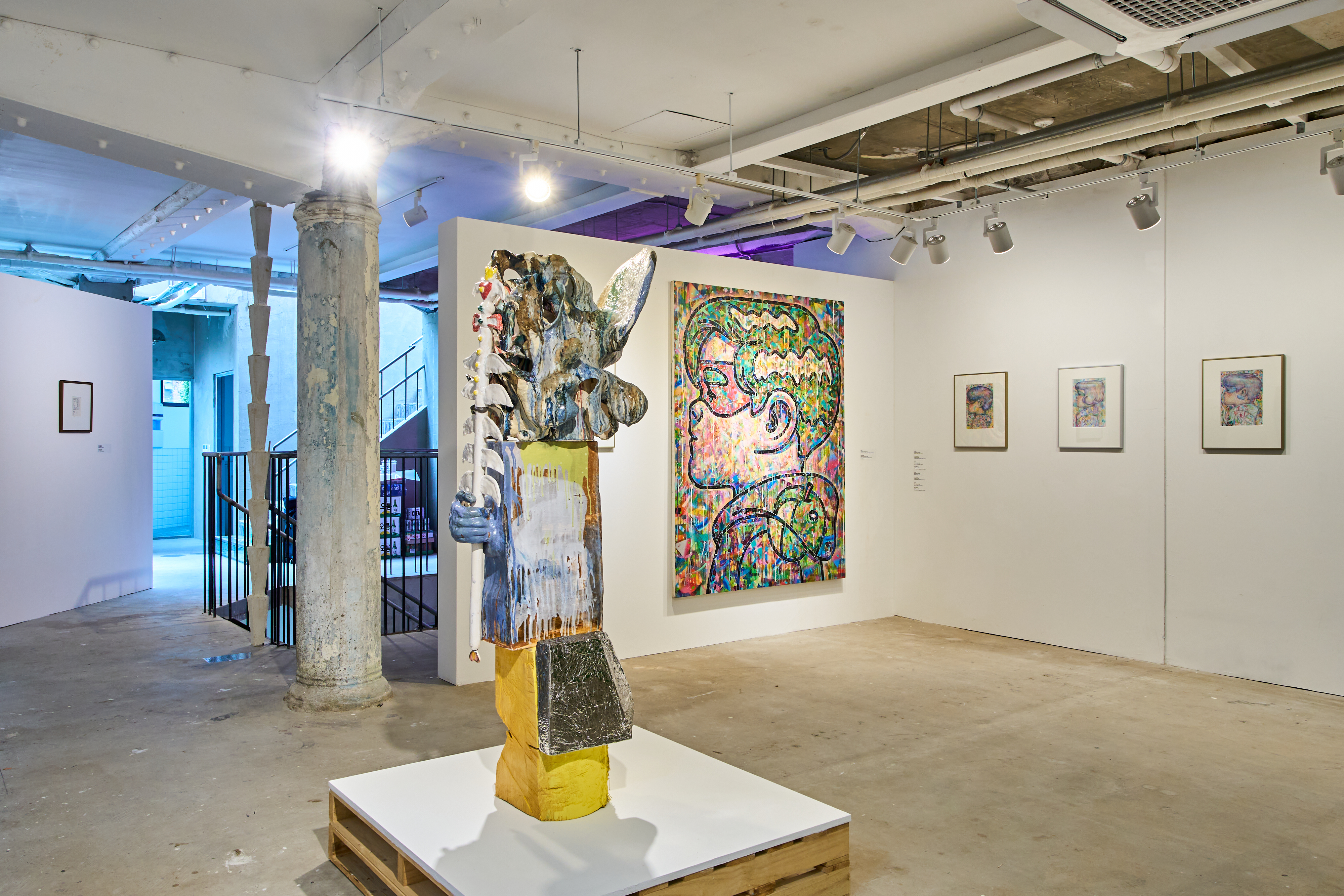
Kim: And that compromise did not remain at a conceptual level and had to be realized within the actual space of the exhibition. We had to ensure that the works did not intrude upon one another, while also preventing them from simply passing by one another indifferently. I vividly remember constantly thinking about the distance between works, which work would become the center at a given moment, and what should be placed beside it.
As in Looking at the Blue World 3, the exhibition I curated just before this one, I wanted to create a scene in which no single work could be read entirely on its own. Rather than a single viewpoint, I was interested in a state where different works collide and interfere with one another, generating new contexts. I felt that this also resonated with the hybridity implied by the theme of “transplantation.”
Although the space of Gallery Remicon, where Washingtonia was held, turned out to be larger than we had expected—which made things more difficult—we tried to create visual points of contact that were not confined to the four categories. I believe that attempt was realized to some extent. Through this opportunity, I was reminded once again that materializing a concept and allowing it to take place in reality is never an easy task.
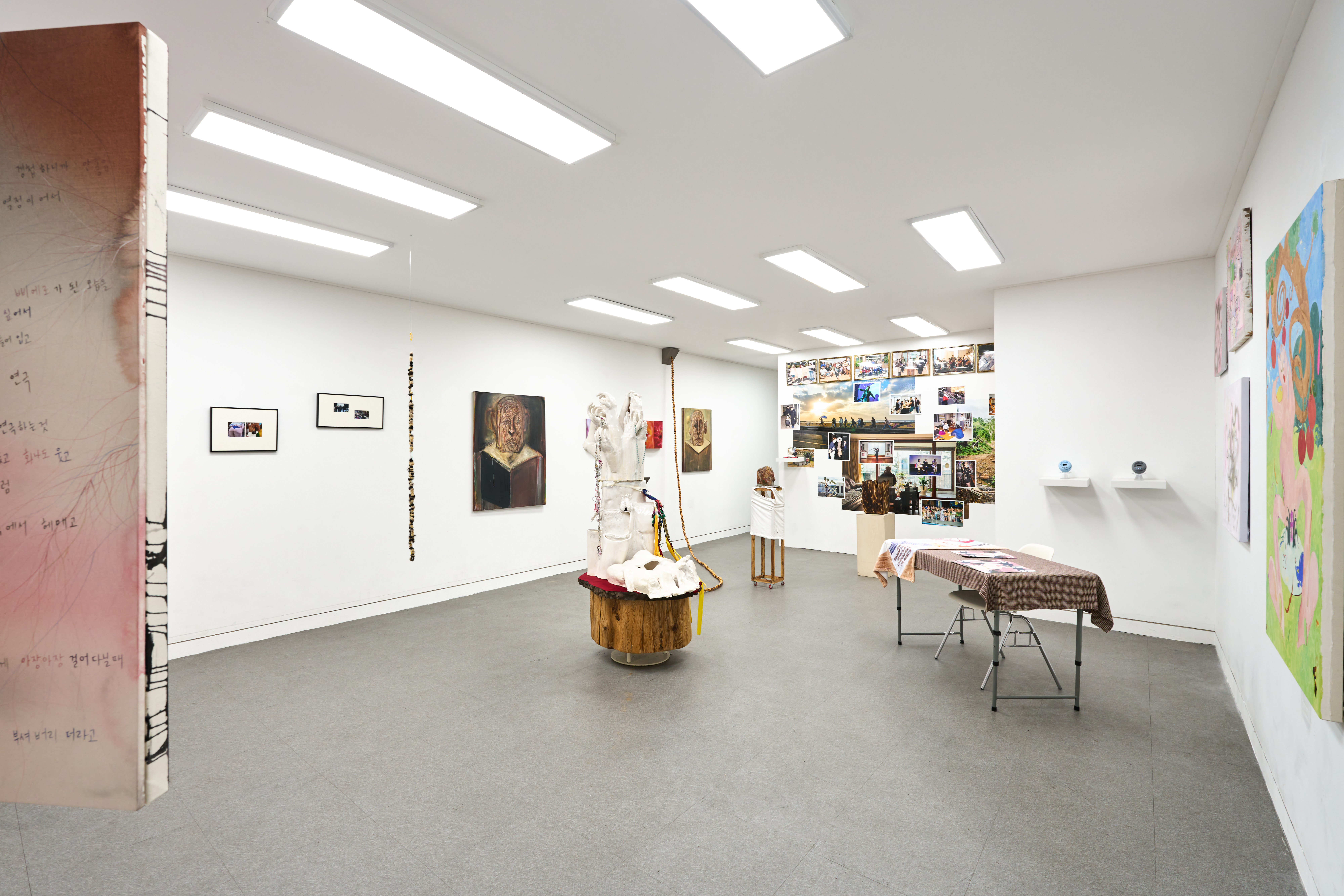
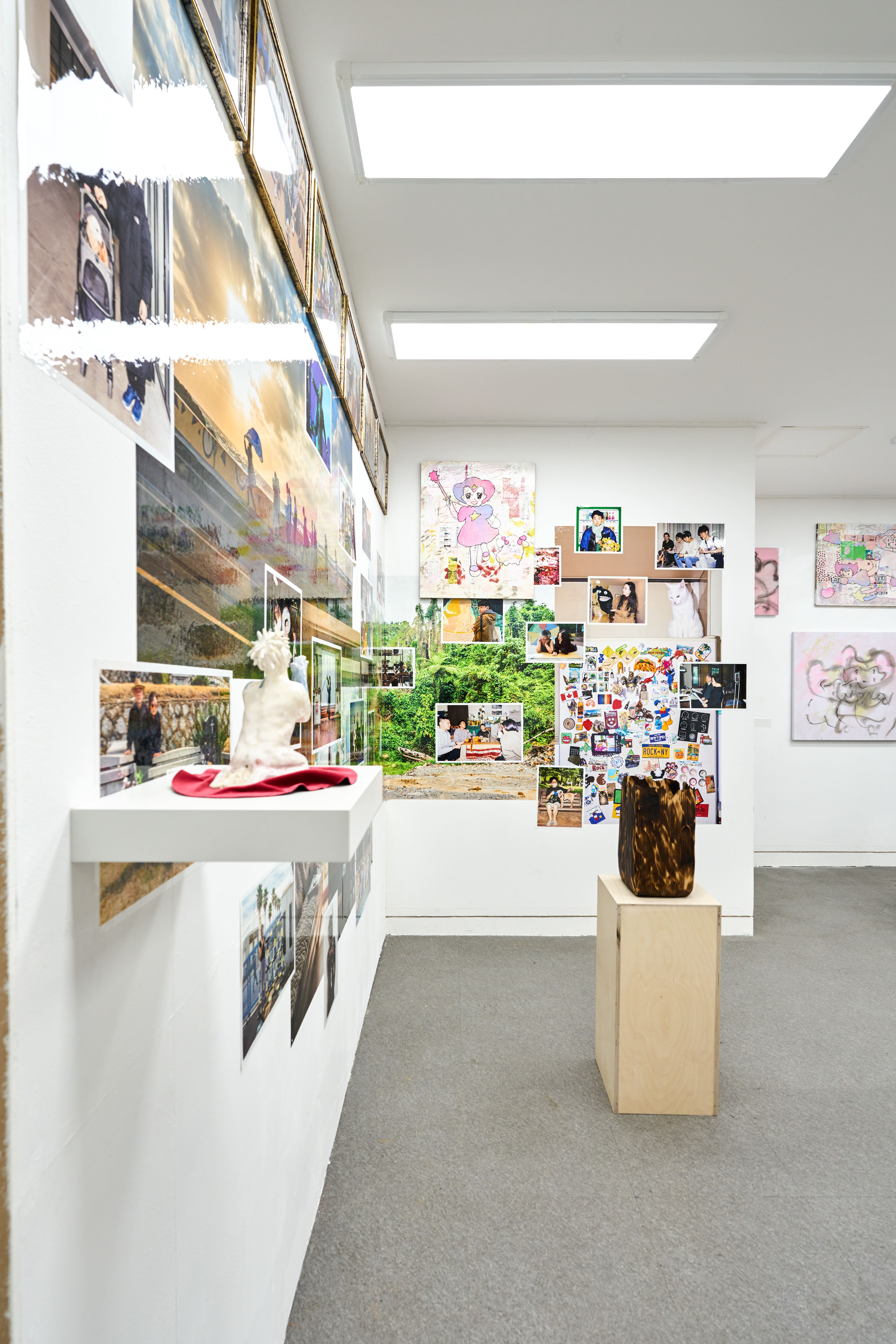
Park: When we were displaying the works for Washingtonia, the artists often asked for our opinions on site. I felt very grateful that they trusted and relied on the curator’s perspective.
But moments like these are not purely joyful. Whenever my opinion was accepted during the installation, rather than feeling pleased, I found myself constantly asking how far I should speak, and whether my words might be guiding the direction of the work too much. I was worried if I was intervening too much in a situation where the artist and I might not be planning the “next” step “together.” The more I am able to speak, the more carefully I find myself choosing my words. A single remark offered at that moment might seep into the work itself.
So although I often think of an exhibition as a kind of three-legged race between the curator and the artist(s), I also try not to forget that the moment we share right now may be only a fleeting instant for the artist(s). Rather than seeking immediate persuasiveness, I try to remain attentive to finding words that can endure over time.
Kim: Listening to you reminds me of Woojung Koh’s solo exhibition Molting4. Rather than feeling as if we had simply prepared the exhibition, it felt like we had crossed a certain stretch of time together. We were on the phone almost every day and worried together about the direction of the work. As a relationship formed in which we could speak honestly about our emotions, the exhibition gradually began to take on a structure of its own.
Park: You’ve continued to maintain a special relationship with the artist even after the exhibition. So this wasn’t a friendship forged overnight.
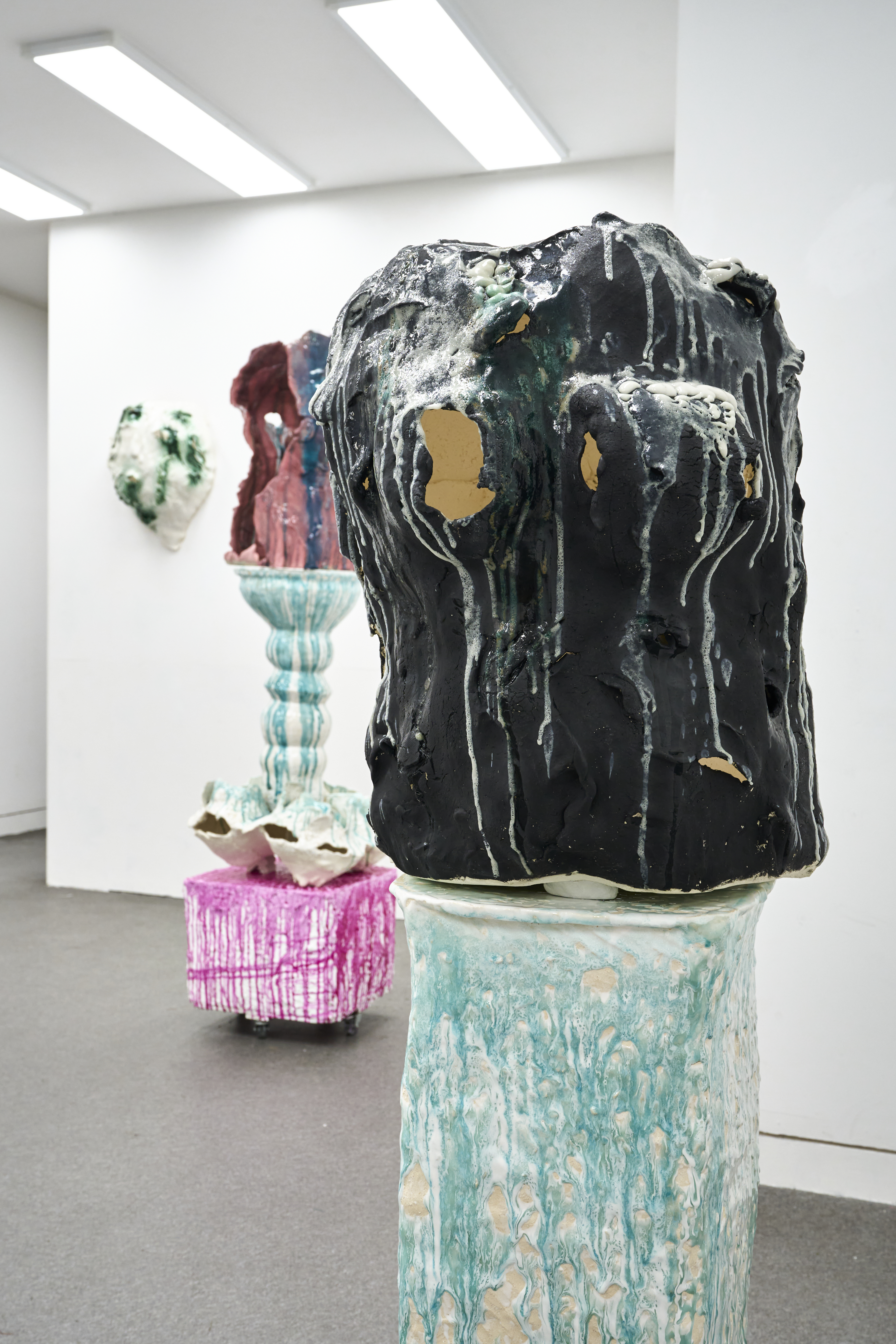
Kim: At the time, the artist was in a transitional period, moving toward new work. Rather than creating figures, she was shifting her approach toward leaving behind shells and fragments. Looking at the thin skin she had cast directly from her body in clay, I read it as "an emotional husk that had separated from the artist yet still carried her traces." When I cautiously offered this interpretation, the artist told me she too began to look again at this work that had departed from her established forms.
From that point, the exhibition gradually took shape. The perspective of reading the flow of glaze as emotional residue; the layered temporality created by different pedestals; scenes that blurred the boundary between sculpture and base. These elements began to weave together not merely as a method of installation, but as a single theme—that emotion is generated within relationships.

Park: Even for me, having known Woojung Koh's previous work, the pieces shown then felt strikingly fresh. The surface and density I had seen in her self-portrait sculptures and vessel-form works had completely transformed. The forms had become incomplete, yet the emotions she sought to convey came through more fully because of it. It felt as though emotion was seeping out from the cracked, ruptured skin and the distorted masses.
Kim: Through that experience, I clearly felt how interaction with the artist shapes an exhibition. The works are certainly made by the artist. But an exhibition feels closer to a thinking environment formed through the exchange of interpretations and questions. A single sentence I offered could unsettle the artist's thinking, and that disturbance would seep into the work. What remained was not explanation or interpretation, but rather the cohesion of time we had passed through together.
Park: Then what was it that we left behind? It's hard to say we changed the work, but it's equally hard to say nothing happened. I find myself thinking that perhaps we were a kind of condition. A speed bump that made the artist pause, or something like invisible air. Perhaps simply a certain kind of environment surrounding the work.
Kim: I agree. I feel that something is truly left behind only when the conversation continues even after the exhibition ends. The works stay briefly in the gallery, but the dialogue remains with the artist and flows into the next work. Even when an exhibition closes its doors, I believe the relationship doesn't end.
Park: In that sense, this conversation we're having now isn't about explaining what we made—it's more like tracing where we were standing. Inside and outside the exhibition, what positions we occupied, what words we offered.
Kim: I like that phrasing. It would be more accurate to say we didn't "make" the exhibition, but rather "stood together in that time."
Park: And that position must have been different for each exhibition. Closer in some, a step removed in others.
Kim: Reflecting on our stance is always something necessary and precious.
Park: I'd like to dress it up nicely and say the reason we add words again after an exhibition is to not forget that time, and the feelings we shared then. (laughs)