*All names in this account are pseudonyms to respect the privacy of people I write about.
I thought it would be a normal day of preliminary field work as I drove toward Richmond, Texas’ Pashupatinath Mandir (temple) one cool October morning. I had already been there once before for the temple’s monthly abhishek ritual, yoga, aarati ritual, and community gathering. However, as I drove to the temple I was still taken aback by the location. Despite Houston’s rich cosmopolitanism, I felt that hardly anyone would suspect that along the stretches of country roads on the outskirts of Houston, along byways leading to fields sprinkled with grazing longhorns and bodies of water full of alligators, that one would find this lone Nepali Hindu temple.
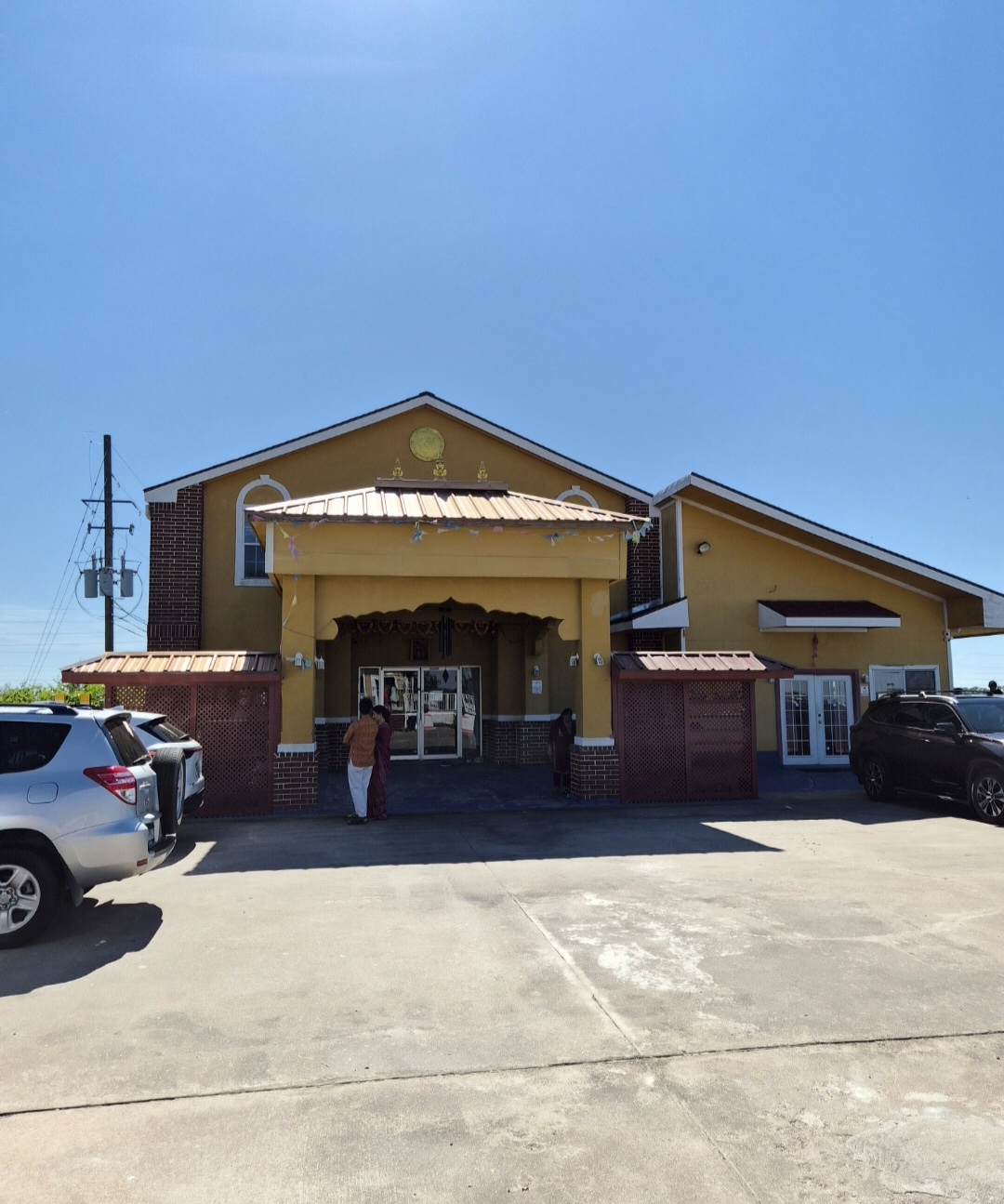
When I arrived, my experience seemed not much different from the last time. I parked my car in the big parking lot and walked up the pavement to the temples. The Pashupatinath Mandir of Richmond has two main structures. One, a small, square, mustard-yellow, wooden temple with white corners, sitting upon a raised wooden platform. The small structure has two sets of white double-doors with lattice windows on its southwestern and southeastern sides, and a window on its northeastern side. Although the exterior walls were built with a very western-style wooden clapboard siding, the roof was made to mimic the pagoda style architecture of the original Pashupatinath Mandir and other temples in Kathmandu. The roof’s two tiers are decorated with small red drapes that flutter beneath the overhangs, while the top tier is complete with a simple metallic gajur pinnacle. The bigger structure, which sits opposite the small one, and contains both a temple and a community hall has the look of something between a big contemporary ranch-style house and a modest event hall. At first glance, this mustard-yellow building would not be recognised as a Hindu temple were it not for the golden Om seal stamped on its front gable. Neither would the building be recognized as Nepali were it not for the ornamental gate in front of the temple with its sloping roofs and three gajur pinnacles made in a style that shares the same Nepali ethos of the small pagoda across the way.

The priest was alone in the small pagoda temple sitting at a little table behind the linga (a representation of Shiva) which had been imported from Nepal. Upon greeting him, he invited me to sit next to him as he pushed around uncooked grains of rice, creating auspicious symbols in preparation for the abhishek. The priest began to engage in some small talk with me as he used a little match box to push the grains of rice around to form a little swastika. Soon enough, some people began to show up. The priest needed his car to be moved, so he asked me if I could hand his car keys to a man named Deepesh, after which the liveliness of the monthly gathering slowly began to arise.
Unlike the last abhishek I attended, people were arriving with banners of various health-based organizations and businesses. It soon became apparent to me that there was a health fair being hosted in the big temple's community hall this Sunday. Inside the community hall, people began setting up tables and hanging their banners. I helped where I could before heading to the yoga class held in the big temple’s main hall. Before the yoga class began, someone had asked me to re-park my car to make room for the large bloodmobile that was pulling up to the parking lot. It was then apparent that this was not merely a health fair but also a blood drive. In my past experience living near a Hindu temple and a Buddhist temple in New York, I had noticed that blood drives are fairly common at some of these temples. Although no one has ever stated it to me directly, I believe one can draw correlations to how a religious site dedicated to Dharmic religions, that carry beliefs of karma and merit, would be a perfect setting for someone to give away their own blood, a source of life, for the betterment of someone else who needs it. However, I did not think of giving my own blood when I saw the bloodmobile.
After the yoga class I lingered around the temple complex somewhat aimlessly before I stumbled across Deepesh again. He was in the temple’s open-air kitchen located on the backside of the community hall, stirring a large pot of khir (rice pudding made with milk) with a big wooden paddle. I tried to ask him what he was making but he did not hear me as the milk began to boil over. Deepesh frantically began running back and forth between the sink and the pot as he tried to add cool water to the khir to keep the milk from overflowing. I quickly jumped into the kitchen and grabbed the big wooden paddle and began stirring the overflowing milk. Together, Deepesh and I were able to settle the milk. I let him know that I was okay with stirring the khir to make sure it would not overflow again. This freed him up to be able to prepare other ingredients and foods without worrying about the overflowing milk.
I did not mind getting stuck in the kitchen. At least it gave me some sense of purpose beyond my academic reasons for visiting. Working in the kitchen, I felt as though I could interact with interlocutors without seeming too out of place. As I continued to stir the khir, Deepesh periodically came over to make sure the rice and milk at the bottom of the pot were not getting burned. I asked Deepesh how he knew how to cook everything in bulk, to which he told me that he used to own a restaurant in Thamel. He later told me that he worked in IT in Minnesota, before finally moving to Houston, where he now works construction. “You used to work in IT, but now you’re doing construction?” I asked.
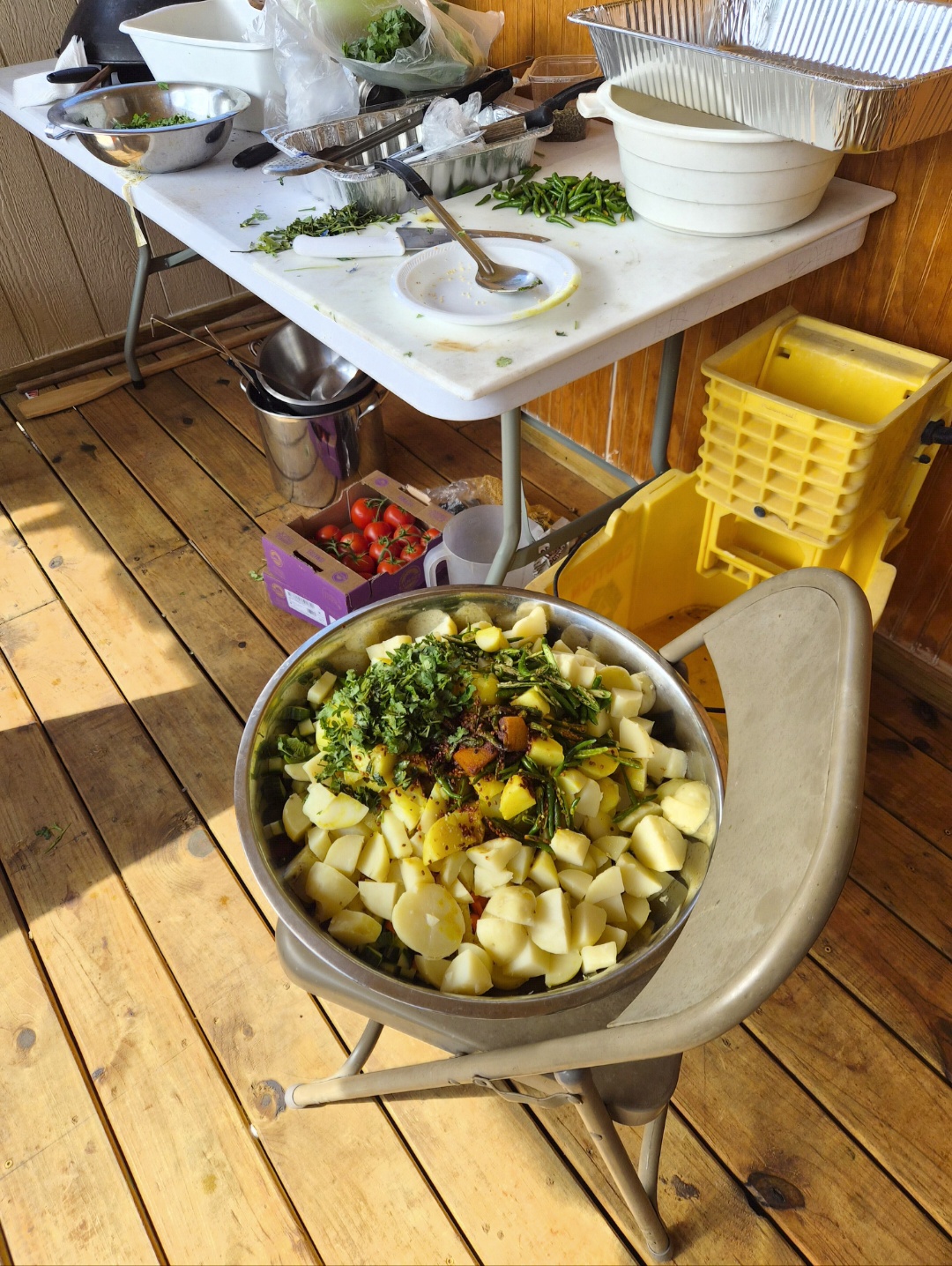
“Yeah,” he said, smiling as he prepped more ingredients. “I went backwards," he laughed. He then went on to explain to me how he enjoys construction work better than his old IT job, that he enjoys the activity involved in the work. As Deepesh and I prepared various dishes in bulk for the community, people would stop by, engage in some small talk, then return to the community hall. Once the khir was ready, we began preparing a large pot of vegetable curry and a big bowl of aaluko achaar (potato pickle). At some point in the midst of all this cooking, it came to Deepesh’s attention that the abhishek had begun, at which point he urged me to follow him quickly through the community hall, back out the front of the big temple and toward the small pagoda temple. There, Deepesh guided me up into the small crowded pagoda where he made sure someone handed me a small brass karuwaa full of milk to pour on the linga. Once we had finished the offering, Deepesh and I quickly rushed back to our culinary duties to finish cooking before the aarati ceremony.
Later, after my use in the kitchen had run its course and I found my way to the aarati, joining the rest of the congregation in the big temple’s main hall where I met the president of the Nepali association affiliated with the temple. I shook his hand and stood next to him beside a bell that hung from the ceiling in the center of the mandir. The aarati began with a rendition of the Om Jai Jagdish Hare (a Hindu hymn) found on YouTube. The soft flute’s notes fluttered out the speakers on the walls, filling the room with calm. As the song broke into a symphony of drum and string the president began to ring the bell above, followed by the priest singing into a headset, “om jaya Jagadish hare, prabhu jaya Jagadish hare…” As others began offering fire before the murtis. Others urged me forward to join in offering the flame. I did this only once before during my previous visit to the temple and still felt somewhat awkward as besides rotating the plated flame clockwise, I was not sure if I was performing the ritual correctly. However, once I had taken my turn, I returned to the back of the crowd. As the hymn began coming to a close, I looked across the room and saw Deepesh enter from a side door. He looked out and called to me, and asked from a distance if I had gotten a chance to offer the fame yet. To which I responded that I had.
With the aarati finished and the food served I looked around outside for a seat to eat my lunch. I sat beside a husband and wife. We asked the usual questions of where each other was from, how long we had been in Houston, and what we do for work. As the conversation came to an end, the couple asked me if I had any intentions to donate blood. I told them “Maybe,” though I had no initial intentions of doing so. They assured me it would be a worthwhile donation, as it can save many lives. However, in my own head, all I could think of was that it would be a good way of showing the community that I am willing to participate in their endeavors, and that I can be trusted when I eventually come back for my official field-work. Although I had donated blood years before, I had since lost my courage and almost blacked out during my most recent bloodwork. I walked up to the sign-in sheet hiding my nerves. I signed my name, but asked if I could take my turn a little later. I went to grab some dessert as I tried to prepare my mind for donating my blood. While ruminating over some sweets I thought to myself, “I must donate blood today. Otherwise, this would be a missed opportunity to engage in participant observation and build rapport in the community.” Finally, although I was nervous, I decided to go forward with it. So, I walked back up to the sign-up booth, where I again saw the president of the association with a blue Coban wrap around his arm. To which I thought, “If he did it, I can do it too.”
Walking up to the bloodmobile, I still felt unready. But just as I made my way to the vehicle, I saw one of its doors swing open. Out stepped Deepesh with a blue Coban wrap around his arm, walking out of the bloodmobile, and walking off with a pep in his step, as if nothing happened, as if he had not just lost a pint of blood. At this moment, I got a surge of courage. As I stepped inside, I saw yet another familiar face. Dr. Ganesh, another community member who I previously met at another Nepali event hosted at the University of Houston. He was reclined on a blood donor chair, as a half-filled bag continued to fill with his blood. Dr. Ganesh turned his head toward me, greeted me with a smile, and asked how I was doing. I believe it was at this moment that I began to realize that my motive, which was ulterior to pure charity, was only enough for me to consider donating my blood. However, what imbued me with the courage to carry out the donation was found in the more genuine connections I felt with the people around me, people I had spent time with, people like Deepesh with whom I connected over the simple task of not letting the milk overflow.