Muljil (jamaekjil) refers to a traditional Korean method of ocean harvesting in which haenyeo (jamnyeo) free-dive into the sea to gather mulgeon(seafood). This muljil, a technique and form of knowledge unique to Haenyeo, can only be acquired through bodily experience. A samchun1 who has lived as a haenyeo for 60 years told me that she “just” went into the sea and began by swimming. Then how can knowing “just like that” be explained? Based on the premise that we know more than we can tell, Michael Polanyi focuses on knowing as a process of indwelling in the body in his examination of tacit and explicit knowledge2. He redefines the hierarchy between the movement of the brain and the movement of the body, and explores a domain that is difficult to reduce to language and rules. In this sense, the attitude of “just” knowing can also be understood as tacit knowledge that is acquired through the mediation of the body. The knowledge of haenyeo, transmitted through stories and the body, is a practice that takes place outside the boundary of language. This practice accumulates through continuous encounters with the material of water—being chafed against it, getting hurt, and pushing through moments of difficulty. The muljil technique embedded in the body has been reorganized into an official narrative through the modern educational institution of the school, and has come to take on a distinct form. Based on fieldwork conducted in 2022, I examined how the knowledge of haenyeo is translated into explicit knowledge and transmitted to young women.
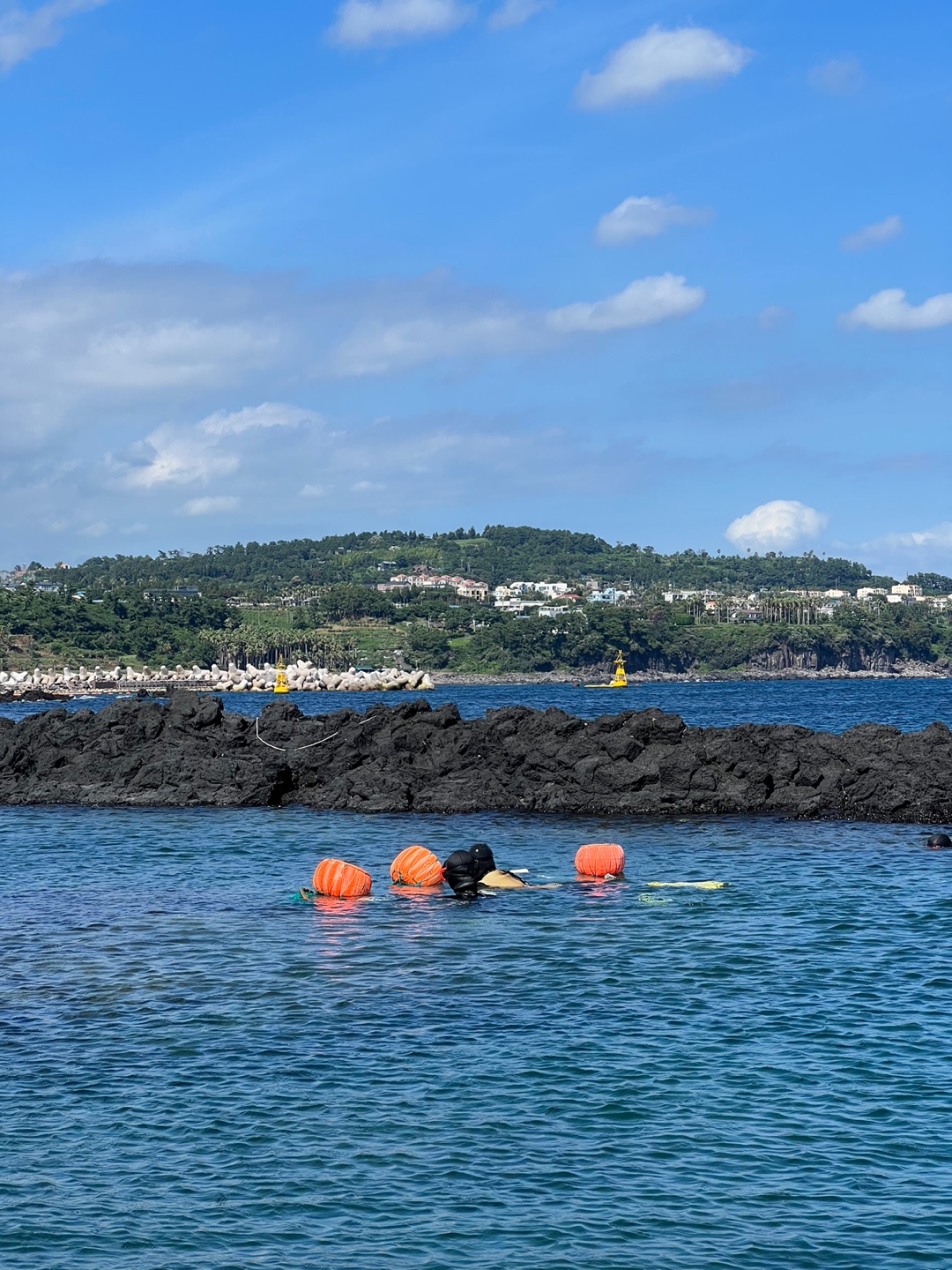
Haenyeo
In Jeju, concerns have become pervasive that the culture and values of haenyeo are disappearing alongside the divers’ life cycles. In response, processes of heritagization began around 2011, leading to the inscription of Jeju haenyeo culture on UNESCO’s Representative List of the Intangible Cultural Heritage of Humanity in 2016, followed by its designation as a National Intangible Cultural Property in Korea the following year. Haenyeo culture encompasses not only the diving practice of muljil, but also a broader range of cultural practices embedded in the women divers’ everyday lives, including bulteok (communal resting spaces), tewak (floating devices), and religious beliefs. Within local communities, not only population aging but also the outmigration of younger generations and potential successors to the mainland has been perceived as a major challenge, resulting in a shortage of women to sustain the haenyeo tradition. The haenyeo school is a training program for haenyeo that was conceived as part of an institutional effort to alleviate this sense of disappearance through cultural recognition.
Girls, until now, have become haenyeo by entering the sea with only minimal guidance from their halmang(grandmothers), eomeong(mothers), and older sisters, learning muljil through observation and independent practice3. However, this mode of learning presents difficulties when it is translated into a text-centered pedagogical system. When I asked the samchun how they practiced muljil, or when I asked about known aspects of haenyeo culture, they often responded with embarrassment or indifference, glossing over explanations with phrases such as “just” or “somehow.” A staff member of the haenyeo school also noted that the samchun find it difficult to teach muljil verbally. The school, in turn, chose to borrow the language of divers in order to render these practices into text. Diving theory, constructed on scientific and biological principles—such as how to cope with water pressure, maintain balanced posture, and regulate breathing—became a tool for transforming locally transmitted knowledge into visual materials that can be read. In this way, diving concepts participate in the reconfiguration of haenyeo muljil into visible knowledge.The embodied knowledge of haenyeo is now placed alongside scientific knowledge.
Divers
Haenyeo School A recruits new students only once a year, in March. Because some students drop out or fail to endure the pressure of the sea, more students are admitted than the set quota. Those who pass the interview attend a total of 86 hours of classes on weekends from May to July; these classes consist of lectures in the morning and practical training in the afternoon (in the latter part, both morning and afternoon are devoted to practice). Some graduates go on to complete a two-month internship4 in a local fishing village association in Jeju in the fall, preparing for the life of a haenyeo. The haenyeo school teaches not only muljil techniques, but also the regulations of the fishing village association—more specifically the 잠수회jamsuhoe (haenyeo association)—procedures for joining the fisheries cooperative, the marine environment, and the history of haenyeo, covering haenyeo culture as a whole. The instructors include professors, officials from the fisheries cooperative, haenyeo, and (skin/free) diving experts5. In the training materials, haenyeo muljil and divers’ diving techniques are presented side by side. In the first class, students learn diving theory from a diving expert, and from the fourth day of practice onward, they are divided into groups and receive one-on-one instruction in muljil from samchun. The remaining students practice in teams according to the safety guidelines of the diving instructors.
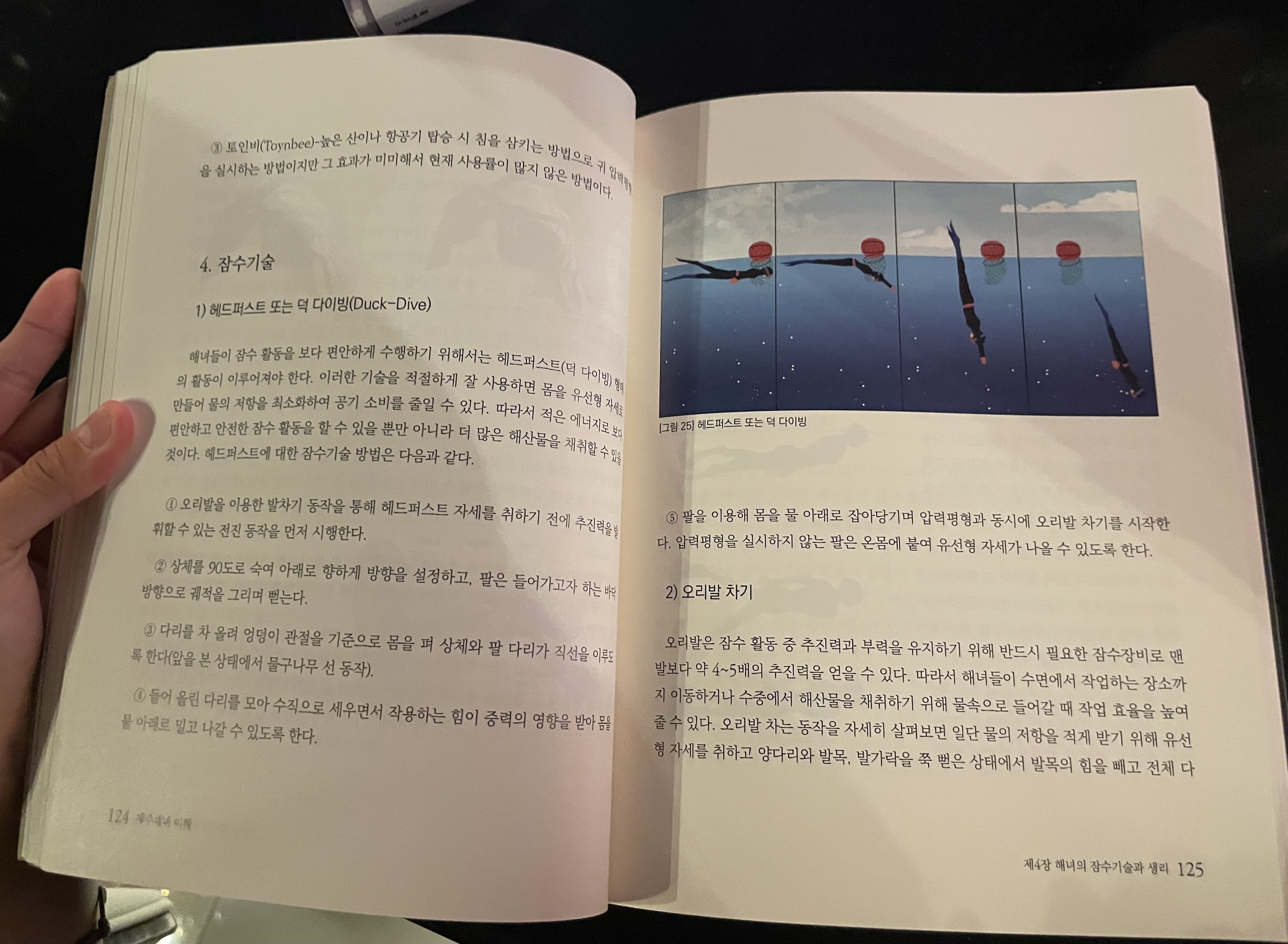
For beginners, the most difficult task is learning how to descend. Wearing weights around the waist makes descent easier, but because it makes it difficult to respond in emergency situations, it is necessary to train in proper diving posture6. This proper entry posture refers to the freediving technique of “duck diving,” in which one enters headfirst and descends at a 90-degree angle. One intern haenyeo explained the difference in entry methods between haenyeo and divers. For example, samchun advise descending slowly until the ears adapt, in order to prevent ear problems, whereas divers emphasize a faster, more vertical descent for efficient use of physical strength. As the depth increases, water pressure also intensifies, causing pain in the ears; at this point, the technique of “equalizing” is used to send air to the ears and regulate pressure. Mastery of this technique allows one to dive to greater depths. In contrast, haenyeo simply swallow and descend deeper. At some point, when one goes down as far as the body allows, one encounters one’s own maximum point and limit. That depth becomes the sea of one’s lifetime. This shows that the spatial range of muljil is determined by individual bodily conditions, and that muljil knowledge is accumulated through the specific body. Haenyeo work within the limits allowed by their bodies, learning the sea through their own movements. Haenyeo also relate to one another as companions—like sisters—and manage the risks of the sea by watching over and protecting each other. This form of solidarity in muljil is taught in a way similar to the “buddy system,” in which two people move together when diving or swimming. In this way, the haenyeo school teaches the process of haenyeo work by translating it into various techniques from free, skin, and scuba diving.
Young Women
At Haenyeo School A, which aims to train professional haenyeo, only women are eligible for admission. In order to cultivate not participants in experiential events but professional haenyeo capable of actual work, the school has established a system of specialized training and internships. This attempt has led to another possibility. From a closed structure in which only locals, gwendang (kindred networks), and relatives of haenyeo could become haenyeo, it has shifted to a structure in which women without local ties can also become members of the fishing village association and haenyeo if they make the effort. Most of the students are young women (in their 20s to 50s) who have come down from the mainland, hold free/scuba diving certifications, or are familiar with water. (In this text, it is too complex to address the relationships between locals and outsiders, and between haenyeo and divers.) They can soon live as novice or baby haenyeo, if they wish (and endure). Unexpected encounters transform each other.
Divers with prior experience who wish to legally collect seafood, and passionate women seeking a more distinctive life, all share a love for water and aspire to become haenyeo. However, this differs from the ways of samchun who have attuned their bodies to a single sea over decades. When multiple underwater experiences meet haenyeo experience, they produce a different form of muljil. Once, at a gathering of graduates, I heard them asking for advice using diving terminology in order to improve their muljil and remain longer in the sea. Some samchun, considering their overworked bodies, tell them to follow the divers’ methods that enable healthier muljil, while others insist on the conventional method of swallowing. As different standards coexist, both women who, in order to inherit the “real” or “traditional” haenyeo, insist on wearing wangnun despite the difficulty, and women who practice muljil while taking care of their bodies within what they can manage, become haenyeo. The earlier process, in which, without knowing the technique of equalizing, one endured pain and forced the body to adapt to the sea, is now changing into a process of regulating one’s body through internet searches and diving training.
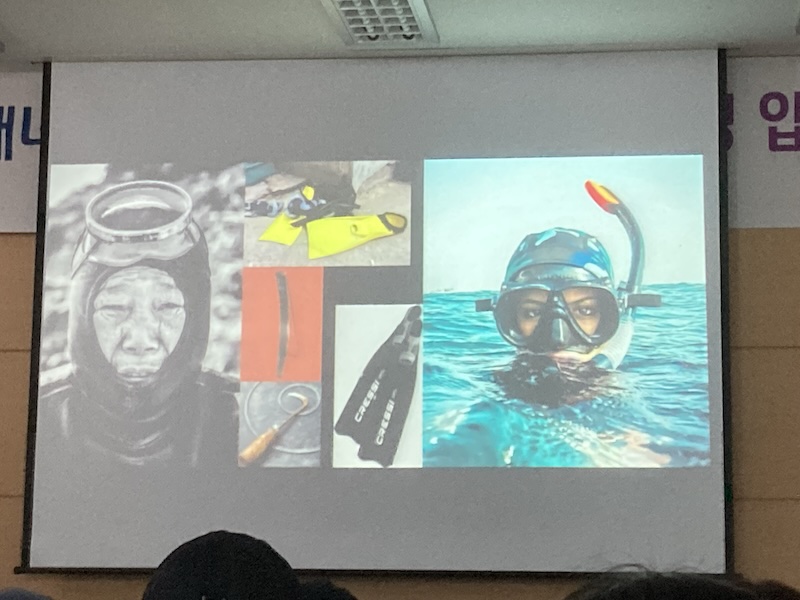
The haenyeo school engages in the mapping of the project of becoming a haenyeo through a series of guidelines. Young women follow these guidelines and are becoming haenyeo in ways different from traditional practices. muljil techniques are reorganized through divers’ techniques; divers as outsiders are incorporated into the domain of the 수; and kinship-based relations are reconfigured into hierarchy(기수제). Knowledge gained by learning the sea—such as the environment of the ocean, the flow of the sea, and reading weather and waves—is no longer primarily acquired through embodied experience, but is first cognitively understood and then matched with practice. In this way, experiences that were once simply undergone are transformed into knowledge that must be learned and imitated. This linear sequence of education leads haenyeo practices to be performed as a systematic “culture.” As a result, this transformation goes beyond simply preserving haenyeo culture; it is also a process of rearranging the sea, the body, and relations themselves. The new knowledge formed at the intersection of haenyeo and divers simultaneously inherits tradition and produces different haenyeo in layered forms.
*This text is based on and reworked from my master’s thesis (2024).