1 One day—I can’t specifically recall the date—I was browsing the digital archive of my field site on my laptop. A title popped up in my Google search. Paradise and Battlefield, Two Faces of Uisin Village in Jirisan Mountain. I clicked the link and started reading it: “Uisin village carries the irony of being not only historically a paradise of Cheonghak-dong2 but also a land of war. …One belief passed down among the people of Uisin is that ‘the end of war is marked at Uisin.’ The villagers, however, believe that the reason there were no casualties in the war is because this place is a paradise.”
I glanced at the village and the vast mountain range that seemed to embrace it. The landscape, all of a sudden, felt foreign.
The last time I visited the senior citizen center of Mount Jiri, I asked them about the conservation policies of the National Park. To my frustration, the conversation kept veering toward stories of war. This time, I decided to let them steer the conversation, listening to whatever they wanted to share. The four women looked at me with indifferent expressions, each wearing loose, flower-patterned work pants that sagged comfortably around their knees, revealing calves mottled like old parchments. Their tanned, wrinkled hands rubbed their legs absentmindedly. They began talking to each other as if I were not there.
The high-pitched woman began speaking about her childhood, recalling how clueless she had been amid the chaos of war. In a strong dialect, she recounted how she once encountered “some men” eating rice from a cauldron. “My mom was out in the fields. Because I was staring at them eating rice, they called out to me, ‘Hey, kiddo, come and eat!’ I was stupid back then, so I talked back, ‘How can I possibly eat those filthy things that people like YOU are eating?’ I thought they were beggars, dirty and wearing black hats. They shouted, ‘You bitch!’”
The ladies burst into laughter.
Puzzled, I asked who these men were.
…
We wandered through histories, skipping timelines and circling back. Their fragmented stories were woven together with their ongoing conversations, shifting in every direction—from the Japanese to the rebels, to soldiers, to policemen.
Vicious Japanese. Vicious communists. Vicious policemen.
One shivered, shaking her head as she recalled an incident where policemen killed an entire family near the rice paddies, forcing the villagers to watch because one of the family members had run away with the ‘rebels’ to the North. Then, they set fire to the family’s house. By day, they were forced to side with the military and police, and by night, the people from the North. Some villagers died. More died in the neighboring village.
The forest was nothing like it is now. Gunfire echoed through the forests, and the skies burned red with the flames that cremated the bodies of South Korean soldiers, while the dead communists were left to rot, their bodies scattered across the forest floor. Human skulls, occasionally found while gathering herbs, were used as makeshift baskets.
“Back then, the herbs were really nice, maybe because they ate the bbeol-dda-ggu [corpses]!” They all started laughing. Once more, I was confused.
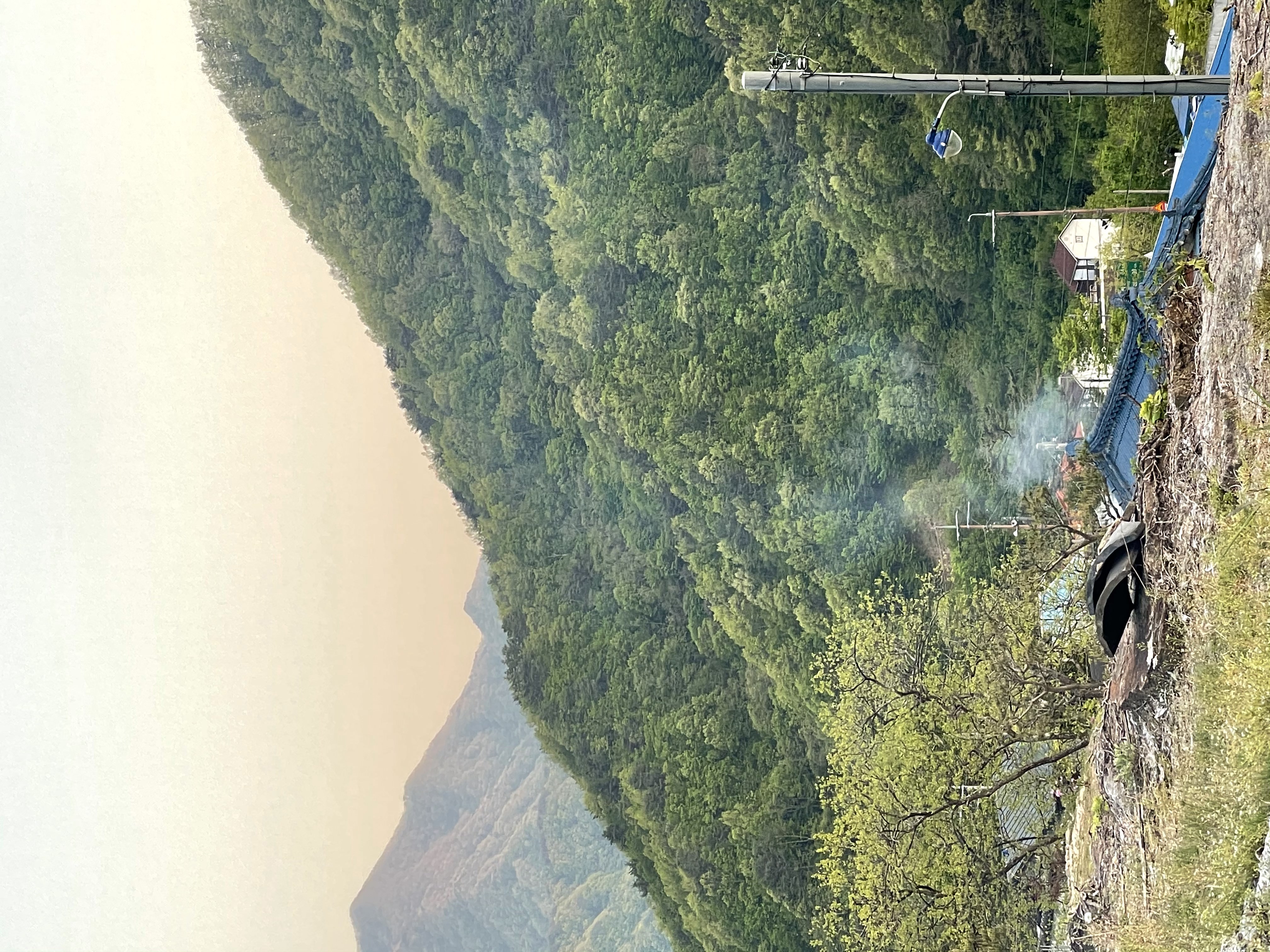
I stared at the windows painted with green forests. The forest now looks flourishing and vibrant, no longer patched with empty spots from slash-and-burn farming or littered with bodies. Yet I found it odd that many of the villagers, including these women, complained about this beautiful forest. They explained that the dense forest cultivated by the National Park Service was endangering small living beings—herbs, mushrooms, wildflowers—leaving them to wither in the shadows of the larger things.
The conversation paused. Perhaps the women were exhausted from the fervent chatting. I was able to hear a rusty fan rattling as it spun and the sound of random TV shows nearby. I found myself spacing out, watching the television aimlessly. After a while, we talked about the arrival of electricity and fuel in the village and the kinds of crops they used to grow on the mountain.
After the long interview, I shared a rice snack I had brought from below the mountain. They scolded me, saying I shouldn’t bring anything since I’m just a poor student, but they smiled as they admired my small gift.
When I was about to leave, one woman—my host’s mother—looked at me and asked, “Did you understand what I was saying? The young people don’t really understand what rural folks like us are saying.”
On the surface, she was referring to the strong and mixed dialect. But I knew there was more to it. I just smiled and nodded.