There is a sensation that the world I encounter returns to me only in the forms that resemble me. Perhaps many people would find this sensation familiar. The familiar arrives earlier than the unfamiliar; agreement comes prepared before disagreement. It usually approaches in a friendly form — so naturally that it becomes difficult to tell whether it is my taste, or whether the environment I live in has already formed my taste ahead of me. But at some point, that friendliness began to feel like it was quietly narrowing me rather than expanding me.
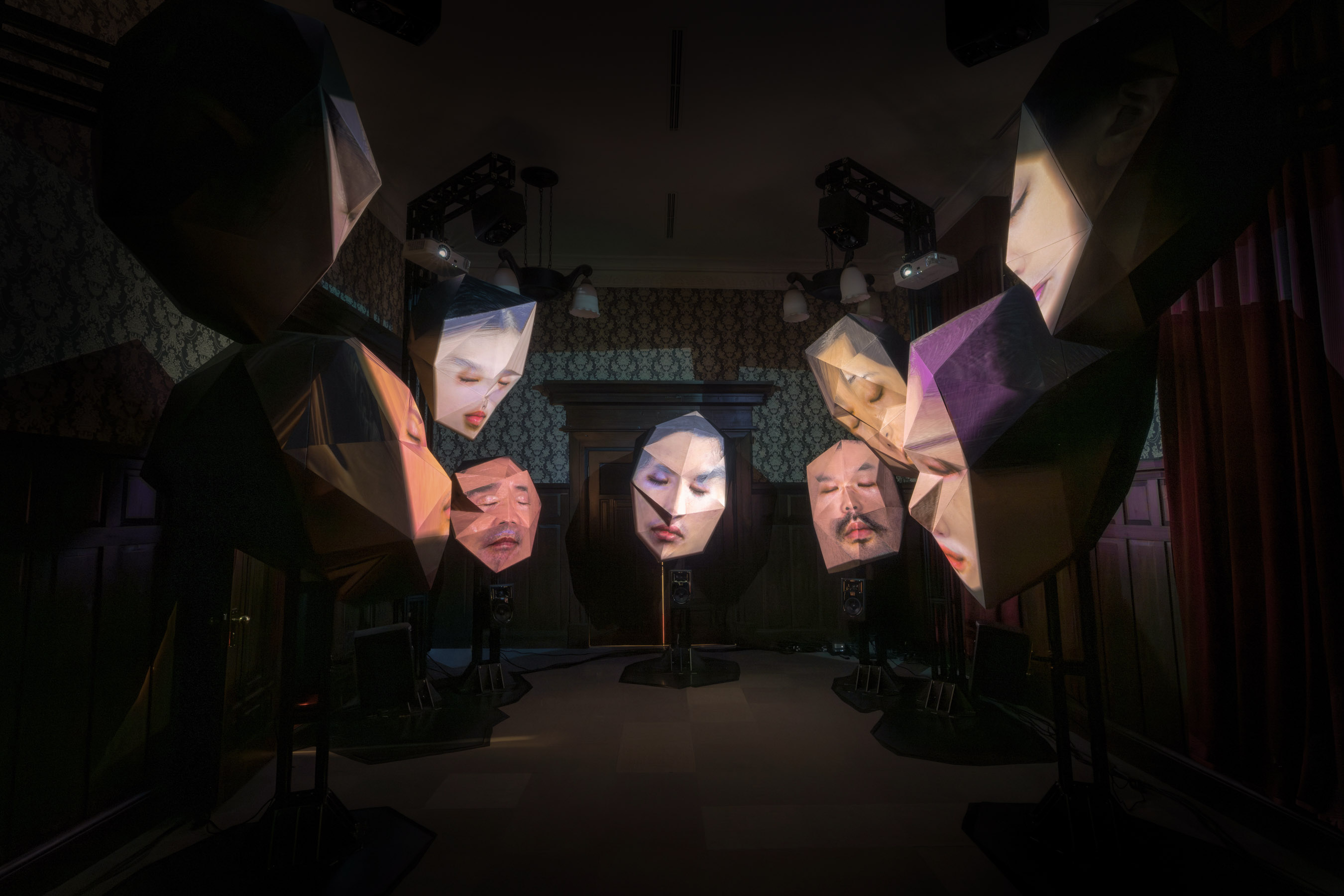
I could call this feeling an algorithm, but what I actually want to talk about is a broader environment: the order of search platforms, the nudges of recommendations and advertisements, the rules of interaction designed by platforms, and even the norms of the society I belong to. This environment doesn't impose specific opinions on me. Instead, it quietly rearranges the grammar of my sensibility — what I find natural, what I accept as obvious, what I push aside as a waste of time. Separate from the sheer increase in the volume of information, there are times when the actual spectrum of the world I encounter feels like it is narrowing. The narrowing tends to be gentle, and fast. Which is why it's harder to see.
The relation between me and the system manifests not only as emotion, but as the repetitive behaviors that emotions drive me into. When I suddenly feel resistance while listening to something, I'm already swiping the screen or pressing the search button with my fingers. Skipping is justified not as dislike but as a feeling of wasted time, and even as I briefly wonder what the rest of the story was about, my gaze is already caught by the next video. Sometimes I scroll down to the comments before watching the video itself, looking for someone else's words that confirm my discomfort. When I find such a sentence, I feel relieved — and that relief in turn determines what I watch all the way through. On other days I open multiple search results in tabs and read through them, but the tabs that have persuasive power survive longer, while the others are quickly closed. Their lifespan is determined less by the quality of the information than by my own criteria for judging what is "worth reading" — and I've come to think that those criteria may not be entirely my own.
It's not exactly clear when these habits formed. Even when I try to recall whether there was a specific moment, nothing comes into focus. What is clear, though, is that my tolerance for unfamiliar things has shortened. From some point on, recommendations hardened in an increasingly similar direction, reflecting what I had been saying, watching, and dwelling on. Thinking this over carefully, my first emotion was resistance, followed by suspicion. Is what I'm currently receiving an expansion — or a solidification?
Of course, confirmation bias itself is not a new phenomenon. Human beings have always tended to accept familiar interpretations more readily and to prefer evidence that supports existing judgments. What unsettled me, then, was not the existence of bias itself, but the speed and density of repetition, and the manner of automation, that emerge when that bias combines with a platform's recommendation structure.
That human beings change through learning is too obvious to say — we always change through relationships, and as we change, we make relationships. What felt like a problem to me was not the fact of change itself, but those moments when change had already solidified into habitual form before I could feel it happening: moments when I only noticed, after the fact, that what I am exposed to, what I repeat, and what I omit had already been too smoothly arranged. From then on, change began to feel less like a path I was making myself, and more like moving along a rail already laid out. That feeling led me to suspect that it wasn't just a matter of opinions — that the very rhythm of my judgment, of what I feel is worth valuing and what I quickly pass by, was changing.
A schema is more like a bodily grammar than a framework for thoughts in the head — a habit of perception and judgment that includes what one finds worth valuing, what one doubts, and what one passes over quickly. We each live with our own schemas, and those schemas are continually updated through relationships. The issue is the sensation that the updating is happening too fast and repeating through too narrow a channel right now. A feeling that while I am watching, clicking, and lingering, the environment is learning alongside me. I thought I was learning the world, but the world that envelops me has also been learning me. Unsettlingly, the repetition was not happening only in me.
From that point, I began to hypothesize the subjectivity of the system. The subjectivity I mean is not an analogy to consciousness, but a hypothesis about the nonhuman agency that constitutes the world. If humans are not the only beings that exert influence on the world, then what kind of relationship do I have with the nonhuman entities around me — algorithms, platforms, and the like? I thought this hypothesis could serve as a lens for perceiving my own situation a little more clearly: instead of cycling through emotions stuck between "my fault" and "society's fault," I wanted to see the mechanism by which these relationships update my schema, the speed and breadth with which that updating occurs, and how much of that process I fail to notice.
This relationship is never one-directional. In some moments the system feels like it is positioning me beneath it; in other moments, I feel like I am using the system as a tool. That’s why I have been calling this an ecosystem. But there is also a sense that this ecosystem is not entirely neutral. The side that collects data and the side that leaves data; the side that designs incentives and the side that ends up mistaking those incentives for personal taste; above all, the side that changes the rules and the side that adapts to them — these are separated, which means this ecosystem is not fully equal.
It was from this feeling that I began my work. I wanted to examine what routes the information I receive travels before it reaches me, how the convictions I hold are reinforced through repetition and omission, and how I come to accept things as "natural" before I have even examined them. So at times I deliberately tried to seek out different opinions and perspectives.
But here a small contradiction arises. The very will to examine automation passes through a platform again. To see more broadly, I have to search more; the more I search, the more refined the recommendations that follow. The paradox of a mind that seeks to verify, leaning ever more deeply on the very devices it seeks to verify. Rather than wanting to resolve this paradox, I wanted to record what forms of emotion it takes in my life: resistance, relief, fatigue, and that strange sense of discontinuity — "the self already updated before I had a chance to examine myself."
And recently, I've noticed the nature of the relationship changing once again. The relationship no longer ends at persuading me. Now it goes beyond recommending what I should do — it proposes to do things in my place. When I think about it, the automation of sensibility and the automation of action may not be separate stages. The more thoroughly the rhythm of judgment — about what is natural, efficient, and worth examining — becomes automated, the more the decision to hand over execution to a surrogate system is made without resistance. The automation of persuasion comes first; the automation of execution follows. From that moment on, my role begins to shift from agent to approver.
I have been sporadically experimenting with an AI agent called "OpenClaw" that recently got popular on Reddit. I've tried having it send emails from a single phone message, or open Notion and organize my notes. The sense of convenience is unmistakable, but as my tasks decrease, the things I need to approve increase. The faster results arrive, the thinner my criteria for judging those results seem to become — and that makes me uneasy. If before I was wary of the sense that my thinking was being adjusted, now the age is approaching in which even agency is being delegated. You instruct in natural language, execution follows, and results are generated without you having to perform the action yourself. The convenience is smooth; the anxiety arrives late.
For now, this delegation of action seems to have flowed into only a portion of daily life, not its entirety. Even just looking at cases like autonomous driving, the delegation of action has already begun. Here, delegation not only means doing things in your place — it changes your position. From doing to checking; from performing to approving. First as an intermediate approver, later as a more macro-level final approver. It may look like a role moving upward, but that upward move does not necessarily mean an expansion of agency. It may instead be a position where the achievement of process disappears and only the responsibility for outcomes remains.
If everyone receives similar advice from similar tools, what differences remain among the approvers? The difference of experience? The ability to establish criteria? Or the habit of granting permission? And if both thinking and acting are delegated, what is left for the individual? If the role that remains for the human being is a repository of responsibility — a final approver — can that life sustain the narrative of experience and process?
What frightens me even more is that all those actions remain as logs. A log is not merely a record; it becomes an explanation. I have lived through several moments where record became explanations. Rather than describing who I am, there are times when I recall what I have done and what I am doing — my records — before my own memory. And recently, a trend swept through of asking ChatGPT things like "tell me my curse" or "tell me my weaknesses and how to improve them." I, a frequent ChatGPT user, tried it, as did people close to me, and GPT seemed to know each of us well. I felt a strange dread in that scene.
A human being is not a bundle of fixed attributes, but lives in a state of becoming — one that includes trial and error, hesitation, and detour. Rather than converging on some conclusion, we make ourselves by swaying in many directions. Yet log-based self-understanding can cut that swaying into explainable pieces, classifying and flattening it in the direction of prediction. A world where the record explains me before I explain myself; where the system knows me best, not I myself.
What I fear is not the record itself, but losing the right not to be fully explained. The right to remain unexplained. Human beings are complex, and they grow by reaching toward things they do not even know about themselves. That is why, in my work, I have tried to let failures and misalignments remain rather than smooth performances. Imperfection was both an aesthetic and an ethic — a form of enduring the fact that one cannot be fully explained. A small, uncomfortable device for remaining oneself.
As always, I will adapt to change. But adaptation may not mean being unharmed. This writing, too, is not a conclusion but an examination. In what environment, in what relationships, and at what speed am I being updated — and what traces does that updating leave on my sensibility and on the form of my work? The more the boundary blurs between whether the world is coming to resemble me or I am coming to resemble the world, the more often I find myself asking. Is this discontinuity I feel something I feel — or something I have come to feel through the act of approving?