2. From House to House
“Where do you live?”
“Over there in Tamben–at Mama Juli 1. You take the Makale main road, then turn off toward Balian…”
“Ah, Mama Julie! Is that Mama Juli of Pani’ [neighborhood]?”
When I had just begun my fieldwork in Toraja, I would invariably use the word “house” whenever referring to someone’s home — ”at Mama Juli’s house” (T: jo banuanna Mama Juli) 2 or near “Papa Toni’s house”(I: dekat rumahnya Papa Toni). It wasn’t long before I noticed that people rarely spoke this way. They simply say “at Mama Juli’s”(T: jo Mama Juli) or “near Papa Toni”(I: dekat Papa Toni) — as though “Mama Juli” and “Papa Toni” were not just the names of people, but names of houses in their own right.
In the neighborhood of Pani’, there are around twenty such houses, each called by a person’s name. Conversations about the neighborhood’s events, large and small, are thus full of names in which people and houses are intertwined. “They’re slaughtering a chicken at Papa Toni’s today!” means that the Papa Toni family, who live at the foot of Mount Situang, are holding a feast. Similarly, tomorrow evening, there will be a family worship service “at Mama Joni[‘s house],” which is near the northern boundary bordering the neighborhood of Lima, and one morning there will be a communal work for house repairs “at the neighborhood head[’s house].”
My house in Toraja was “Mama Juli” — the fifth house on the left, going along the Balian fork from the entrance of Pani’ neighborhood. The name “Mama Juli” is both a person’s name and a house’s name. Received as an adopted son by the woman named Mama Juli, who has three daughters and two grandchildren. I lived together with her family in a wooden stilt house called “Mama Juli.” From then on, whenever people asked me “Where do you live?”, I answered “Mama Juli’s,” gradually finding my place on the map of houses named after people. I was now a person of Mama Juli’s3 in Pani’s neighborhood—a neighbor of Papa Toni, Mama Joni, and the neighborhood head.
“Where do you live [stay]?" (T: umba munii torro?) is a question one must ask and answer whenever forming a relationship with someone in Toraja. At first, I would answer with a place name: Makale, Tamben. People would then ask again: “Who are you staying with?” or “Whose house is it?” What the question “Where do you live?” really seeks to know is, above all, the name of the house one lives in—that is, the name of the person who represents that house. The question is, in the end, indistinguishable from “In which house do you live?”
Of course, if the other person doesn’t know the name “Mama Juli,” one must explain the house’s physical location. But even then, a place name like Makale or Tamben is not a satisfying answer. The other person always wants to know the concrete road to the house, and may ask about its appearance and other particulars. Now I must go with them on an imaginary journey, “seeing the road” together, to Mama Juli’s—something like this:
“If we head south toward [the direction of] Mengkendek, uncle—”
“Right, the Makale main road?”
“Yes, the Makale main road—past the town center, there’s the turnoff for Balian, right? Left turn there.”
“Right, left turn.”
“Yes, the house is right on that fork.”
“On the right? Or left [of the road]?”
“Left. Uh… the fifth one, uh… the one with a gazebo below.”
“Stone house? Wooden house?”
“A wooden, stilt house”
“Oh, I already see [know] the road.”
When he says he has “seen the road,” it means he knows the way, but this is no mere figure of speech. In this journey conducted in words, we have truly seen the road together. Our journey is not over until the road to Mama Juli’s is clearly visible in his mind. Once he has “seen the road,” he is now ready to come to know me as a person. Or rather, he is ready to come and find our house, Mama Juli’s. Likewise, if I am to “know” the other person, I must “see” the road to his house and know how to find my way there.
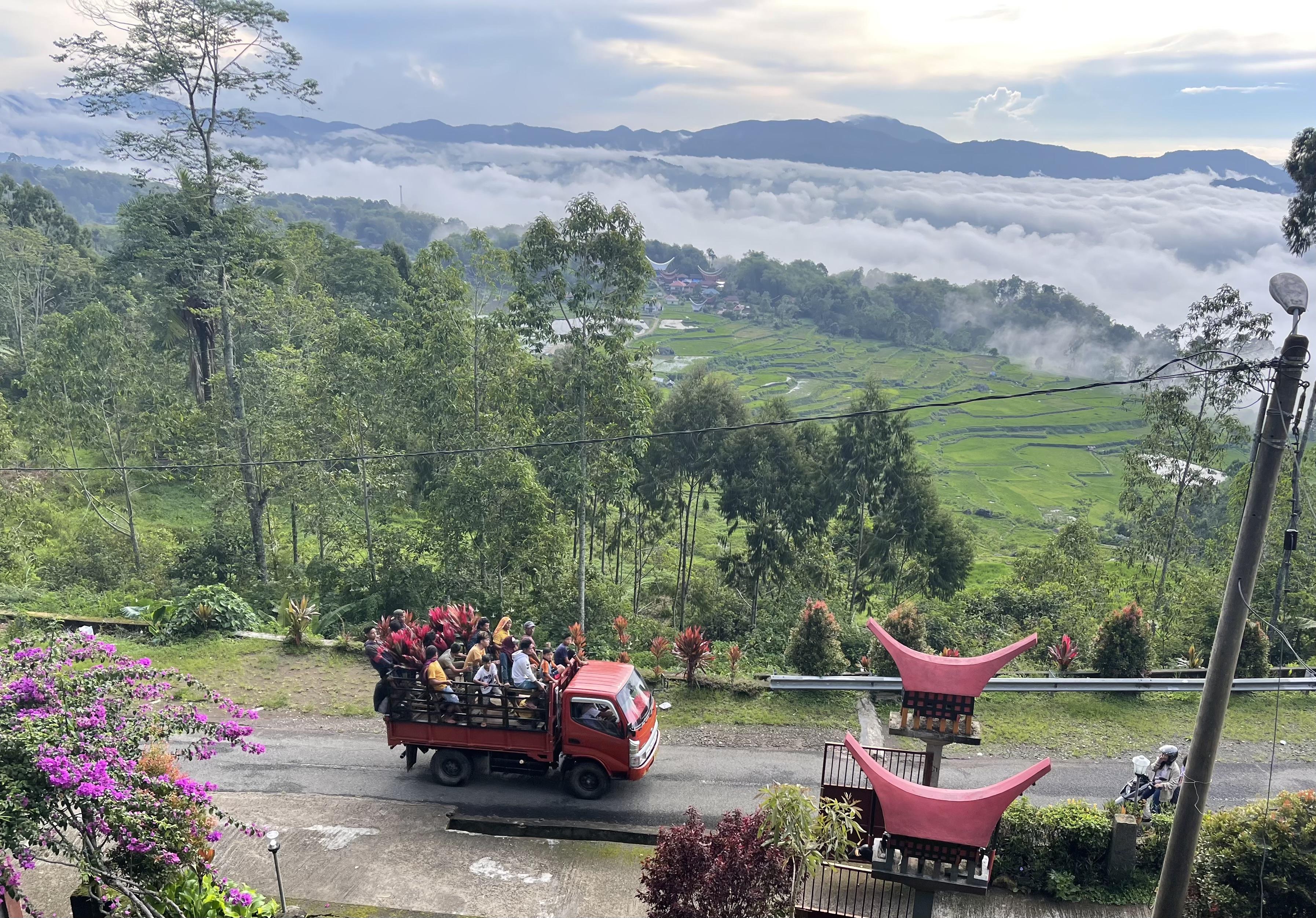
And so, asking and answering where each of us lives, I came to know the people of Toraja. At the same time, I learned to know a person’s name as the name of a house, and conversely, to remember a house’s physical and geographical existence as one remembers a person’s face. This was, in turn, to learn to imagine the geography of the Torajan highlands—embroidered with mountains and rivers, rice paddies and fields—as a map connected from house to house, and to relate to people within that map.
In this “map” that Waterson4 has written about—a geographical and social map in which houses and human lives are intertwined—relationships between people are at the same time relationships between houses. Then, to truly know someone is to know their house and the road to it. The close relationships between neighbors who live physically near one another goes without saying. The Torajan word “Sangbanua” used to mean neighbor, has its primary meaning “one house” or “the [one] whole house.” To be neighbors is to know one another as “one house” and to interact as each being a “whole house.”
Neighbors, therefore, must know each other’s houses, and must know the road to their houses (or “must have seen the road”), so that they can visit. As we have seen, however, this is a prerequisite not only for neighboring relationships but for all personal relationships. Visiting from house to house, namely “massangbanua,”5 is the most fundamental form of sociality in a society of houses where people relate to one another as “one house” (sangbanua) to “one house.” As the double meaning of “massangbanua” suggests (“going to one house” and “becoming one house”), this is a form of fellowship in which people visit each other’s “one house,” and in which visitor and host get along as “a house” together.
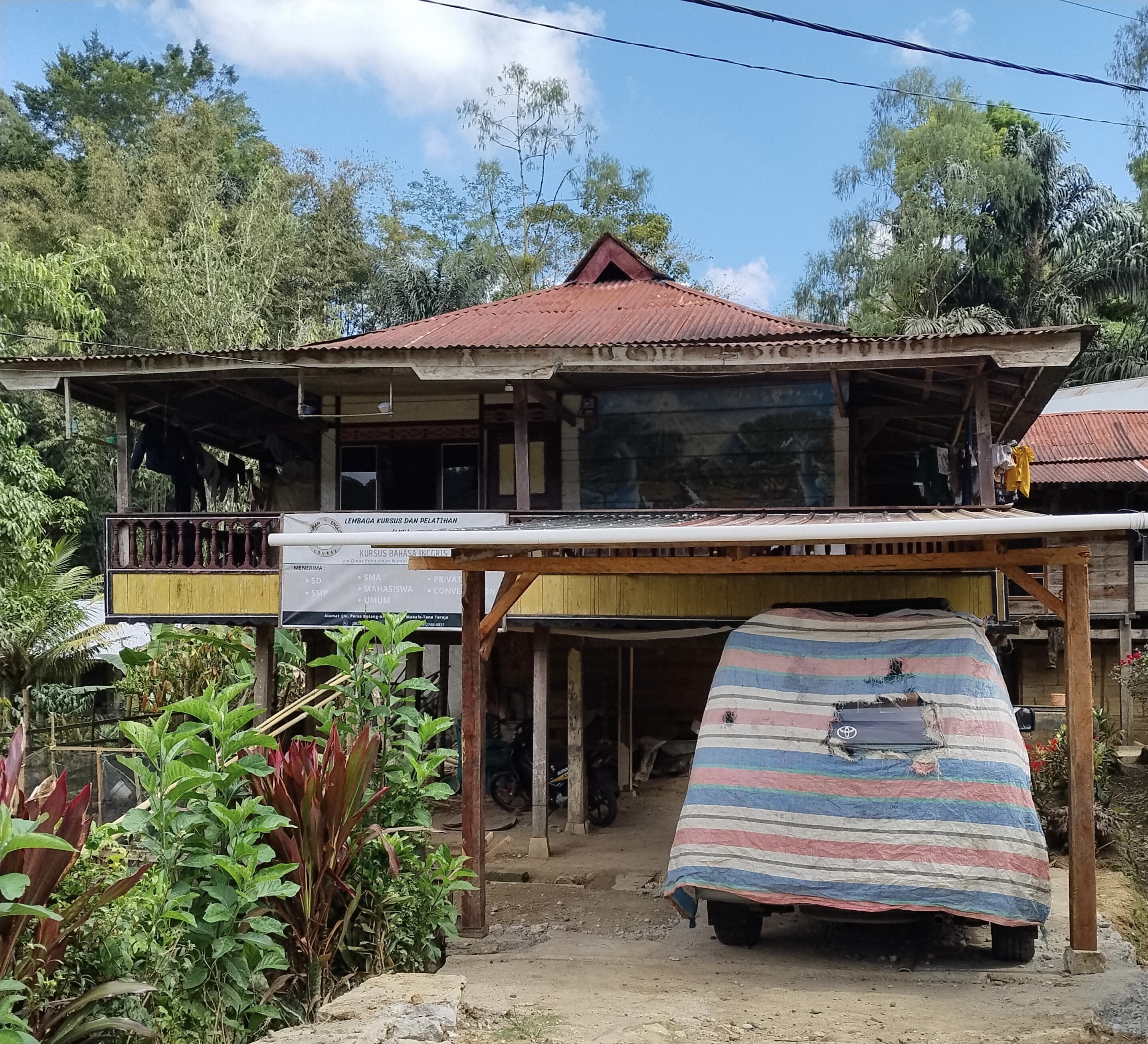
The Torajan house, which Donzelli6 described as a “house full of holes,” is always ready to engage in such fellowship. The door, always open before dark, and the windows and gaps scattered across the walls admit the presence of even the most unexpected guest without fail. The people inside, too, are always poised to detect this presence and step forward to welcome the visitor. So it is at Mama Juli’s in Pani’s neighborhood. When the sound of a car or motorbike horn is heard, or the voice of someone calling out “Hello!” as they walk up, we, the people of our “Mama Juli,” begin to move as “one house.” Someone peers over the terrace railing to check who has come and how many, and announces it to the whole house at full voice. Someone rushes to the kitchen to prepare refreshments; someone else arranges seating on the terrace or in the living room. When the guest finally steps up onto the terrace7, whoever has been keeping the door calls out: “Please sit!” ((T: unnoko’komi!) Once the guest is seated, we sit with them too, and over bread and cookies, coffee or tea brought out from the kitchen, we exchange news of each other’s families.
This is a small specimen of the “feast” (T: pa’maruasan) that is inseparable from any social gathering in Toraja. Sometimes this feast goes beyond refreshments and extends into a communal meal, so that the gathering of people from different houses gradually takes on the character of a community eating and drinking in one house. For this day, at least, the people of this house and that house become “family of commensality” (T: to sikurin; “people who eat from one pot”). When the hours of eating and drinking together as one family have stretched late into the night, we offer the guest: “Stay at this house [tonight]!” (T: Torro bangkomi inde banua!) If they don’t refuse, they lay down on the guest room bed or a mat in the living room and “stay” in our house tonight.
When we visit their house someday, much the same will happen. They too will offer their house as a place to eat and drink, and then as a place to lay one’s body down through the night, returning the hospitality. Going and coming, from house to house, we grow closer, we become a warm and friendly “one house.” A relationship of going back and forth between houses is thus one not only of knowing each other’s homes, but of two houses becoming “one house,” with one or the other serving as the seat. The words a homeowner invariably offers a guest—”Make yourself at home!”—are not merely courtesy. To truly eat and drink and sleep together in each other’s houses as a household member of the “one house,” this is the logic of Torajan hospitality.
Here, there is a “gift” of hospitality that moves back and forth between houses. Maussian gift-giving is often understood, as in the kula, as the exchange of physical goods like necklaces and bracelets. Yet in The Gift, Mauss clearly had in mind something more: the exchange of courtesies as well. “What they exchange is not solely property and wealth, movable and immovable goods, and things economically useful. In particular, such exchanges are acts of politeness: banquets, rituals, military services, women, children, dances, festivals, and fairs (...).”8 The potlatch, which Mauss presents alongside kula as a representative example of gift-giving, is fundamentally a gathering where food, feasts, and celebrations are offered to welcome those assembled.
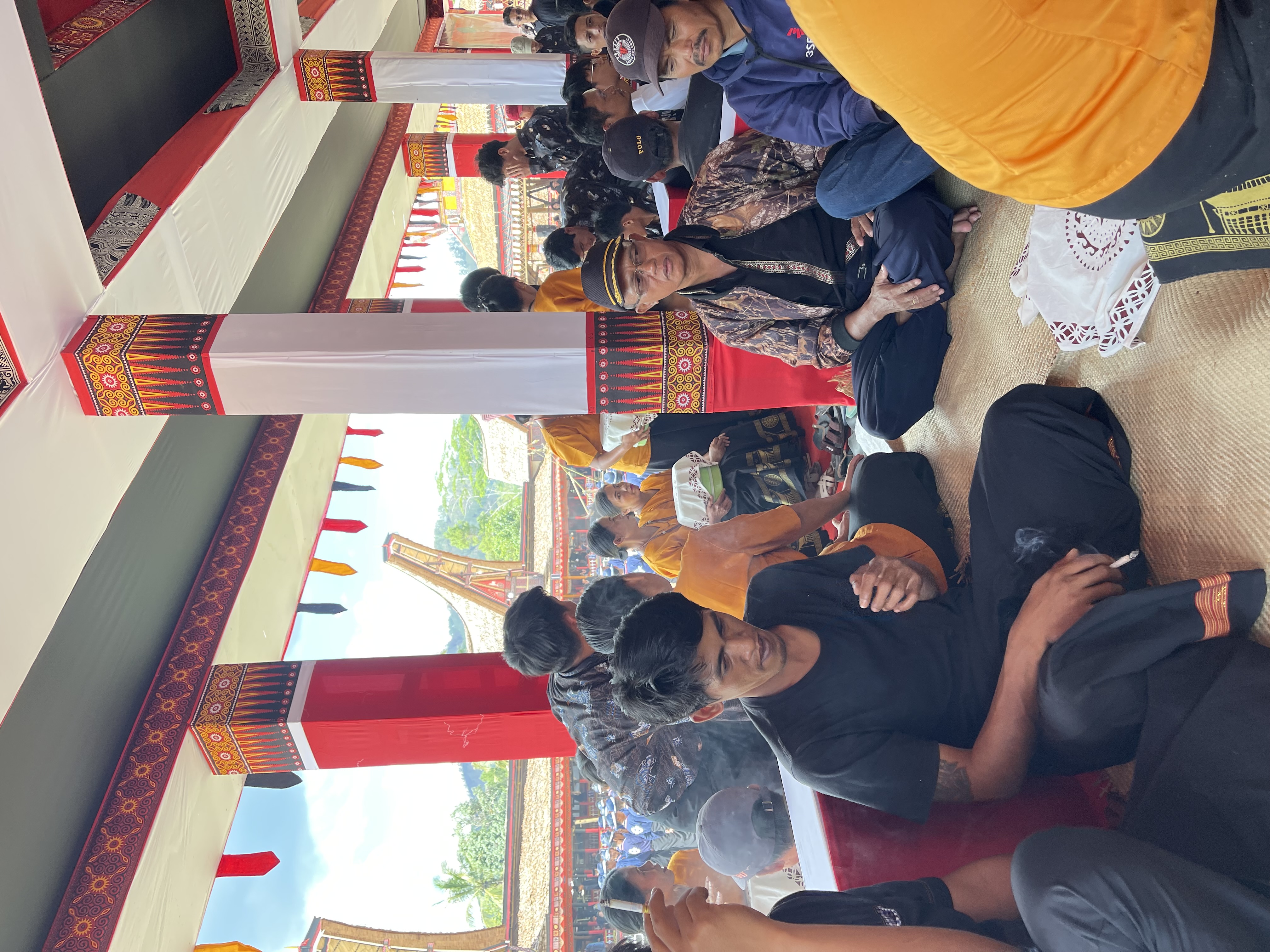
Likewise, the Torajan house becomes a seat where the “courtesy” of hospitality is extended to an arriving guest. This courtesy may not be “things economically useful,” yet it is not immaterial either. Torajan hospitality is, above all, the offering of a house—a supremely material “seat.” This is also the offering of “dwelling” itself. The Torajan word for dwelling, “torro,” encompasses everything from “staying” somewhere briefly to residing permanently in a house. And this dwelling is the same act as sitting—unnoko’, tongkon. It is for this reason that “kaokoran,” derived from the root “oko’” of “unnoko’,” means both “seat” and “abode,” and that the literal meaning of tongkonan, the ancestral house, is the place of “tongkon” — that is, “the place of sitting.” Hospitality is, at the very least, to offer one’s house as a seat of dwelling, as if sitting and dwelling were one and the same, inviting the other to “sit” and “stay [dwell].” As a seat for eating, drinking, resting, and sleeping together. Fellowship is thus a fellowship in which host and guest exchange seat and abode, mediated by the house.
What has been described above is a scene of everyday fellowship—light and impromptu—but sometimes the fellowship of houses takes on a weightier significance. The fellowship of sitting together in a house to eat and drink can become the occasion for marriage proposals, the making of betrothals, and the celebration of marriages that have come to pass. The house is also a seat of fellowship for mourning the dead. Visiting the house of the deceased is, in particular, the highest form of courtesy between houses. The house in mourning becomes the site of a series of condolence visits, “ma’tongkon,” beginning with “makadudu,” the immediate visit to the house of the deceased.
The weight of significance brings with it the weight of courtesy, and the weight of the gift. The two parties to a wedding visit each other’s houses and offer gifts, and guests and well-wishers offer a certain number of pigs or water buffalo in the name of their “house.” Conversely, the people of the hosting house must in turn lay out a more lavish feast than usual and carry out a more elaborate ritual. All of this, of course, exceeds what an ordinary house could accommodate. The feasting house extends beyond its own building, literally growing larger—awnings are raised in the front yard, temporary structures are erected, folding chairs are lined up to make seats for many.
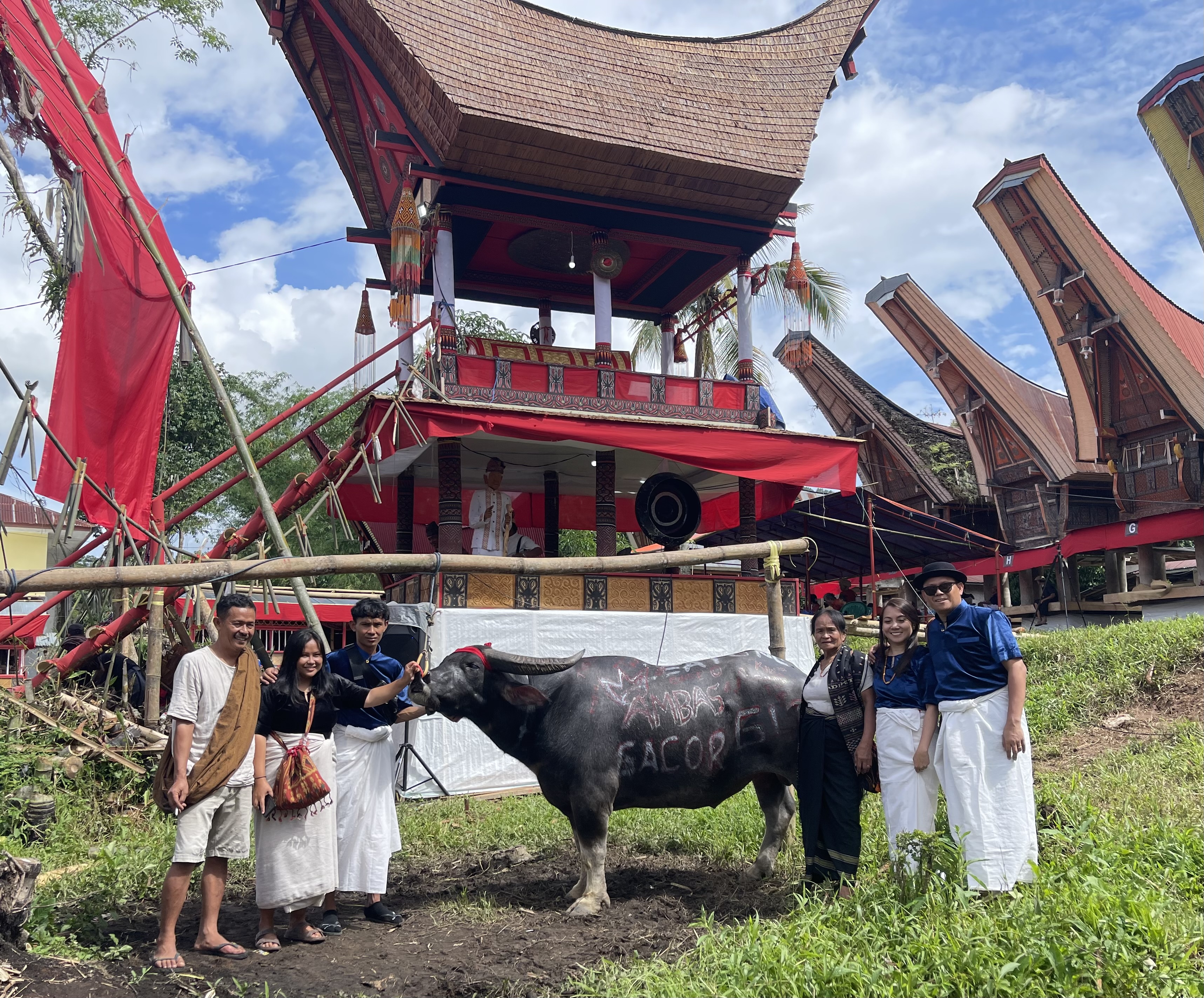
Especially a tongkonan hosting a feast must be “larger” than other ordinary houses. It has to be large enough not only for all the kin members belonging to that tongkonan, but for the many guests who come to call, along with the water buffalo and pigs they bring. From the very outset of its construction, a tongkonan must therefore be equipped with a broad front yard holding space for many seats. It is no coincidence that tongkonan means “the place of sitting.” The tongkonan is a great “seat,” and in the most literal sense, a “big house.”
Thus in Toraja, all social fellowship, regardless of its scale, takes place in and through the house, which is at once a seat of dwelling and a seat of hospitality. Torajan society is a society in which the house is not merely a place of residence, but a privileged social space and medium—a society that is, in the fullest sense, a “house society” (société à maison)9. In this house society, the bonds between people are threaded together by the roads that lead to one another’s houses: roads traveled to mourn the dead, to celebrate a family’s joyous occasion, or simply sit together with cherished friends and eat and drink.
Yet the same roads are, for some, roads that are particularly affectionate and that are longed for. For these are the roads of return —to the houses where they and their families, their parents and ancestors, have lived their lives. The people who share these longed-for roads are family and kin. It is now time to speak of these families and kin—of the life they share, bound together by a “house.”